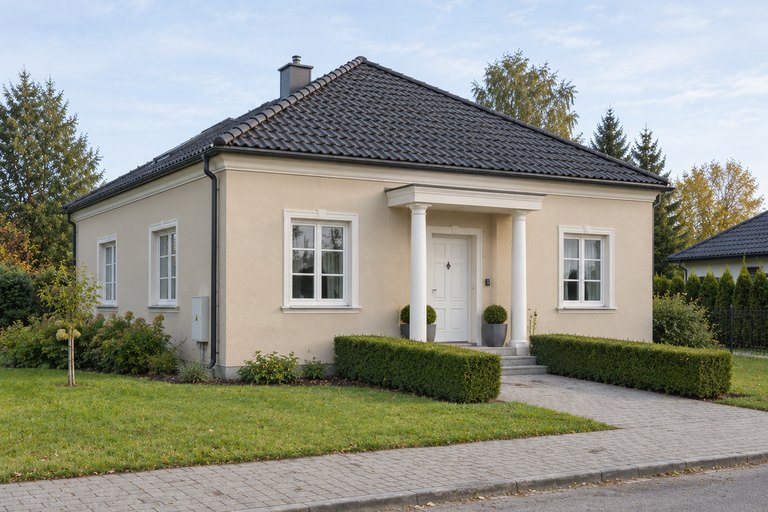
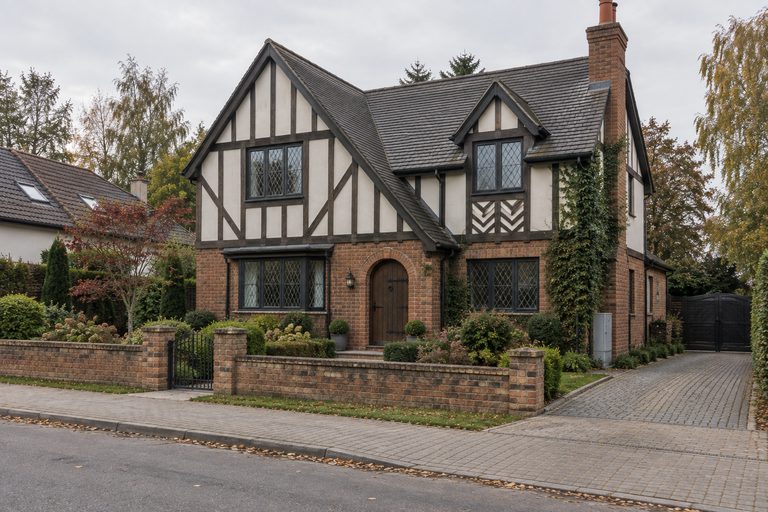
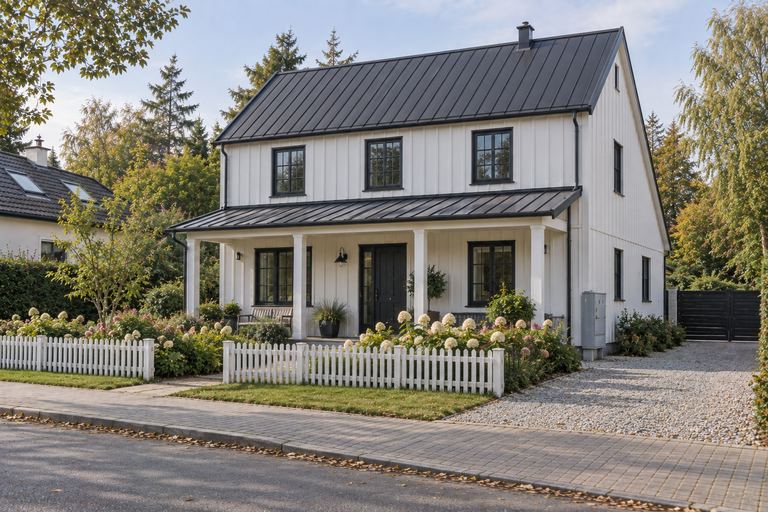
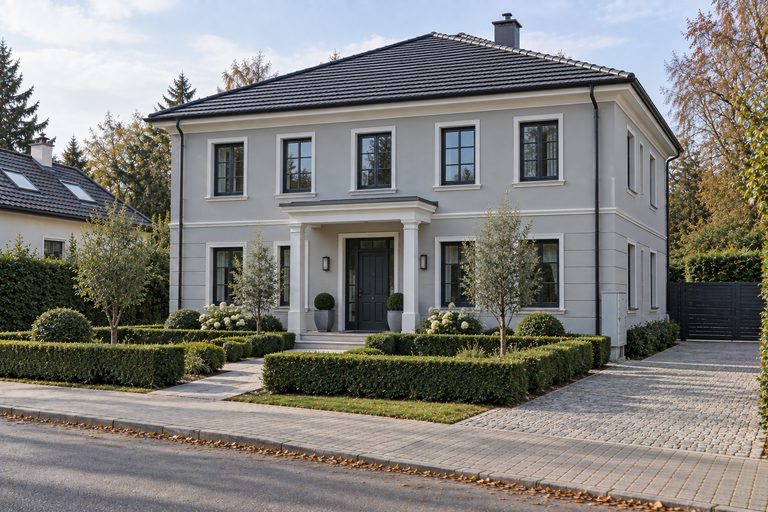
A facade in art déco style
Geometric ornament, gold accents and a firm rhythm — 1920s elegance.
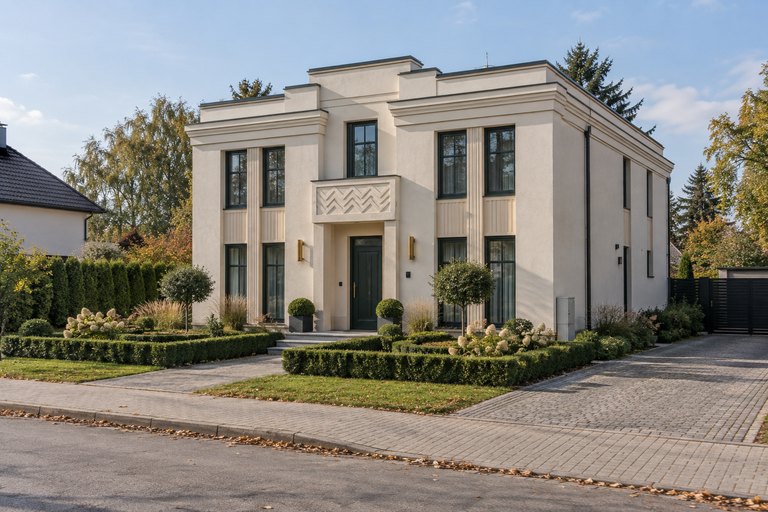
Art déco is for people who are not afraid of decoration. It is characterised by geometric ornament — zigzags, sunbursts, repeating bands — pronounced cornices, and pale renders set against gold or brass accents. Everything is ordered and symmetrical, but far more decorative than in classicism.
On a detached house, art déco works best in its muted form: cream or sand render as the background, darker window surrounds, and one strong geometric motif above the entrance or in a band under the eaves. Gold appears in spots only — the house number, the lamps, the door handle — never across a whole wall.
It is a good direction for houses with symmetrical massing and a pronounced entrance. Because the style lives on detail, a sense of proportion decides everything: the same ornament can read refined or overdone depending on its scale. A visualisation lets you test that without the risk.
Which houses it suits
- Symmetrical houses with a formal entrance
- Buildings with a flat roof or one hidden behind a parapet
- Owners who want a facade with character and detail
Colours and materials
- Creams and sand renders
- Black and deep graphite-green details
- Gold and brass accents
Common questions
Can art déco ornament be added to an existing house?
Yes — facade profiles made of coated polystyrene are fixed to the finished wall. That is cheaper and lighter than forming the detail in render.
Will gold accents look kitsch?
Over a large area, yes. Art déco works when the gold is spare and set against a calm background. It is worth comparing a version with and without it on your own photo.
Similar styles